
Enrollment closes Wednesday, June 24th.
YOU HAVE ALL THE PLAYS. YOU STILL DON'T HAVE AN OFFENSE.
The problem was never your plays. It's that nothing underneath them tells you what to call when the defense rolls to a look you didn't plan for.
Picture this.
It's a Saturday morning in March. Your coffee's still warm. Your wife took the kids to a birthday party an hour ago. You sat down at the kitchen table with a fresh notepad and last year's cutups, telling yourself this is the weekend you finally start building the offense.
Two hours in, you have the same thing you had at 9 a.m.
A list of plays. A folder of YouTube clips you've been meaning to watch. Six tabs open on your laptop. And a pit in your stomach that says you've done this exact same Saturday morning four years in a row.
You're not lazy. You're not unprepared.
You're a serious coach doing what serious coaches do, and the way the offseason is set up, even doing everything right leaves you back here in March, holding the same pieces.
Now picture a different Thursday night, eight months from now.
You're at the dinner table with your family. Phone face down. Laptop closed. You're not half-listening to your daughter because your brain is stuck on the third-down package. You're actually there.
The game plan is done. It's been done since Monday. You spent a couple focused hours building it instead of three nights agonizing over it, because the system underneath it told you what belonged and what didn't.
Your practice focus hasn't changed since August. Your QB is going to step into the huddle tomorrow night with the same offense in his head that he's been running since the first day of camp.
Tomorrow night is just another rep of what your kids already know.
You go to bed early because there's nothing left to do. The work is done.
Tomorrow is the fun part.
No second-guessing. No flipping pages. No half-second of guessing when the defense rolls something you didn't plan for.
Just calling the game. Guiding your kids through what they've been running since August.
That Thursday isn't a fantasy.
It's just on the other side of decisions you haven't made yet.
And there's a reason you haven't made it. Probably four reasons.
Let me name them.
Belief #1: "If I just gather enough, the right clinic, the right cutup, the right book, the system will emerge from the pile."
It won't. Architecture isn't downloaded. It's designed. The coach with five binders of notes and the coach with one organized offense are not at different points on the same path.
They're on two different paths entirely. One is collecting. The other is building. More collecting will never become building.
Belief #2: "I just need better athletes."
The most comfortable lie a coordinator can tell himself. If the problem is the roster, you're off the hook.
But the great high school offenses aren't great just because they have great athletes. They have a system that makes average kids look fast, smart, and dangerous.
The Flexbone program that hangs 40 on a team with three Division-I commits doesn't have better players.
When you say "I just need better kids," what you're really saying is "I haven't built anything that flexes around the kids I have."
The kids you've got are the kids you've got. What you build around them is up to you.
Belief #3: "We need to be running what's successful on Saturdays and Sundays."
So you watch college football on Saturday. You watch the NFL on Sunday. You see the explosive plays, the tempo, the motion. And you bring it back.
Spread concepts from Saturday. RPO packages from Sunday. Pre-snap motion stacked on pre-snap motion.
The thing that makes their offense great isn't the wrinkle you saw on TV. It's the architecture you didn't.
You can copy any play you see on Saturday. What you can't copy is the architecture that makes it work.
Same Message all Offseason
"Tired of starting over every June."
"I'm walking into year four as OC and I still don't know what my offense actually is. I just know what's been working."
"I've been to four clinics this offseason. I have notes from all of them. I can't make it fit together."
These are all message I've received this offseason, the same problem written three times, by three different coaches.
The thing that organizes great offenses doesn't live in another clinic slide.
It doesn't live in another cutup.
It doesn't live in another coach's playbook on Twitter.
It lives in the architecture underneath the plays.
You don't fail because you lack good plays. You fail because your plays don't connect into a system that already has the next answer built in.
Until you build that architecture, every offseason ends the same way.
You rearrange the same plays into a different binder.
And every fall, you pay for it.
Here's what changes when there's a system underneath your plays.
When the offense is built on a foundation instead of stacked from a list, every downstream piece of the work gets easier. Practice plans get shorter. Game plans get shorter. Your call sheet gets shorter.
But the feeling on the sideline gets bigger.
You stop scanning fifty plays under pressure.
You stop second-guessing your gut. You stop dreading the moment the defense rolls a look you didn't plan for, because you already built the answer into the system months ago.
The work doesn't go away. You'll still install. You'll still game plan. You'll still call a bad one on a Friday night and beat yourself up about it on the drive home. But you'll be doing all of it from inside a system that holds up under pressure, instead of from inside a binder of hope.
INTRODUCING
The Offensive Operating System Live.
OOS Live is a four-week live meeting designed to be used in a single offseason.
It's four live sessions with me. A private community where the build happens between sessions. And it's the founding cohort — the smallest, lowest-priced, most personal version this program will ever run.
By the end of week four, you will have walked through the entire build with me and a room of other high school OCs. Your North Star play, picked. Your run game stacked around it. Your pass game built off the same look as the run.
Your install schedule written, day by day. Your weekly game-planning process locked in.
When you walk into camp in August, the offense is built.
Who I am, and why I built this.
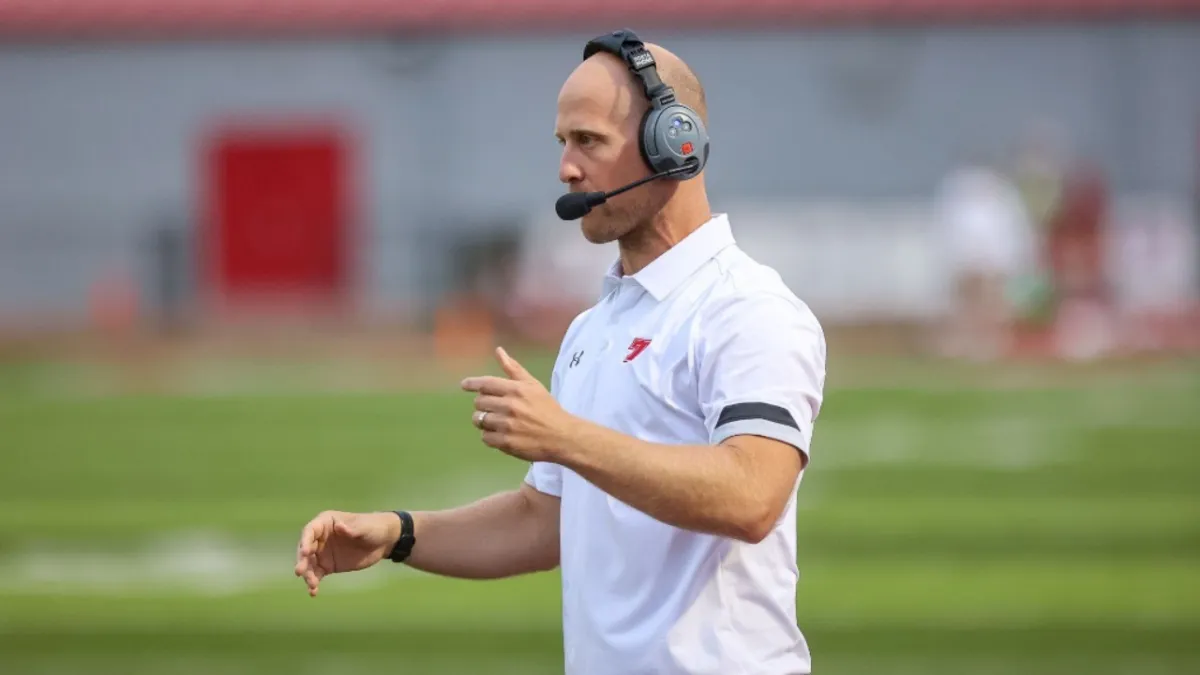
I'm Preston Troyer. I'm a high school offensive coordinator. I've been calling plays for over fifteen years.
I built OOS Live because for the first six of those years, I was the coach this page is written for.
The moment that changed it for me was a 10-3 win.
We won the league championship that night. First undefeated regular season at our school in sixty years.
That was the night I realized I didn't have an offense. I had a list of plays.
That night we played a team that knew what we did. They bottled up every run. We couldn't get a chunk. We couldn't get a rhythm. I kept reaching for the next thing on the sheet. We won 10-3 because our defense and our talent dragged us across the finish line.
I made a decision that offseason. I wasn't going to chase any more clinics. I wasn't going to add more plays. I didn't need more plays. I needed an offense.
I rebuilt my offense around that idea. We went on to break every offensive school record at my school — scoring, yardage, wins.
Since then I've helped other high school OCs do the same. Not by handing them my plays. By teaching them the architecture so they can build a system around theirs.
OOS Live is that architecture, taught in real time, in a room.

"Appreciate what you went through to get where you are and the work you're doing to keep people from having to learn the hard way."
Jacob Warren
What you get, and what each piece does for you.
Session 1: The Architecture
We start by teaching you to read the field the way the defensive coordinator across from you already reads yours. Run box, immediate pass space, deep pass space. The three forms of conflict your offense has to create every snap. Then we pick your North Star — the one play your entire offense will live on. By the end of Session 1, you'll know what your offense is.
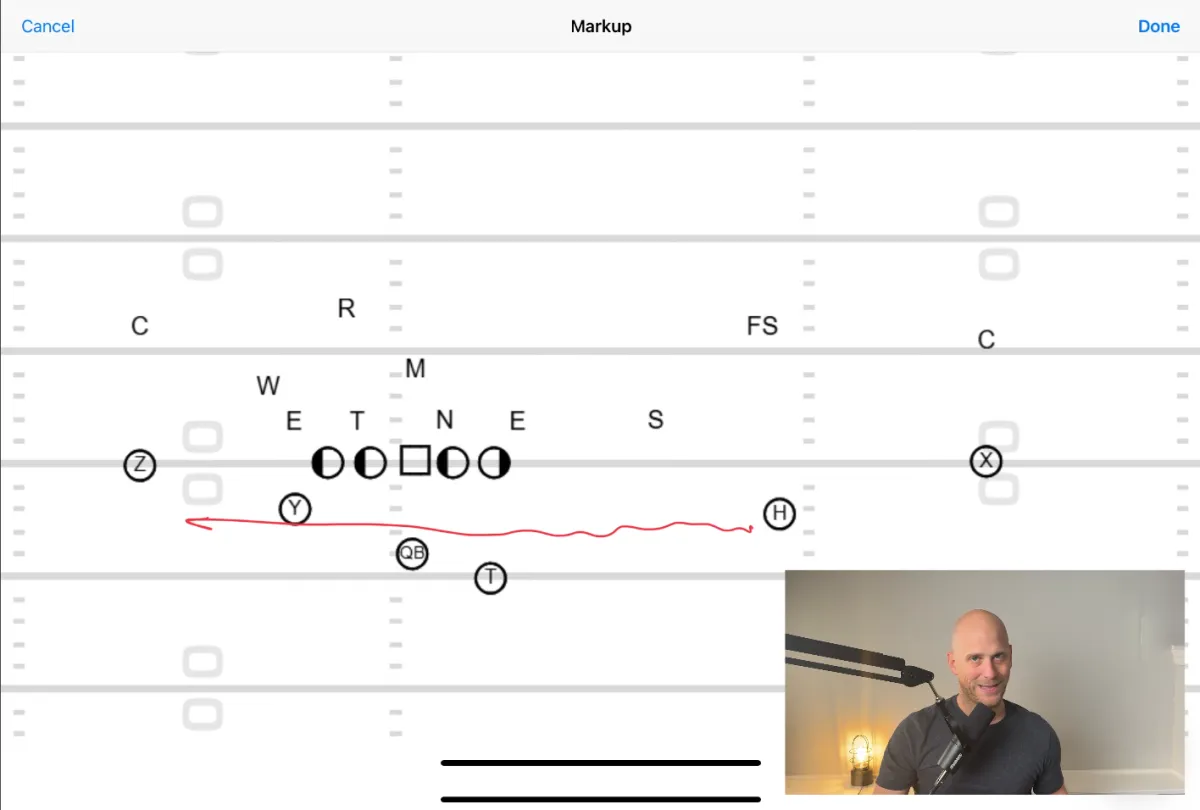
Session 2: What goes in?
You have your North Star. Now you decide what gets built around it.
This is the session that answers the question every coach gets stuck on: how do I know what to add and what to leave out?
By the end of Session 2, your run game is stacked, your pass game is built off the run, and every play in the offense has a clear job to do.
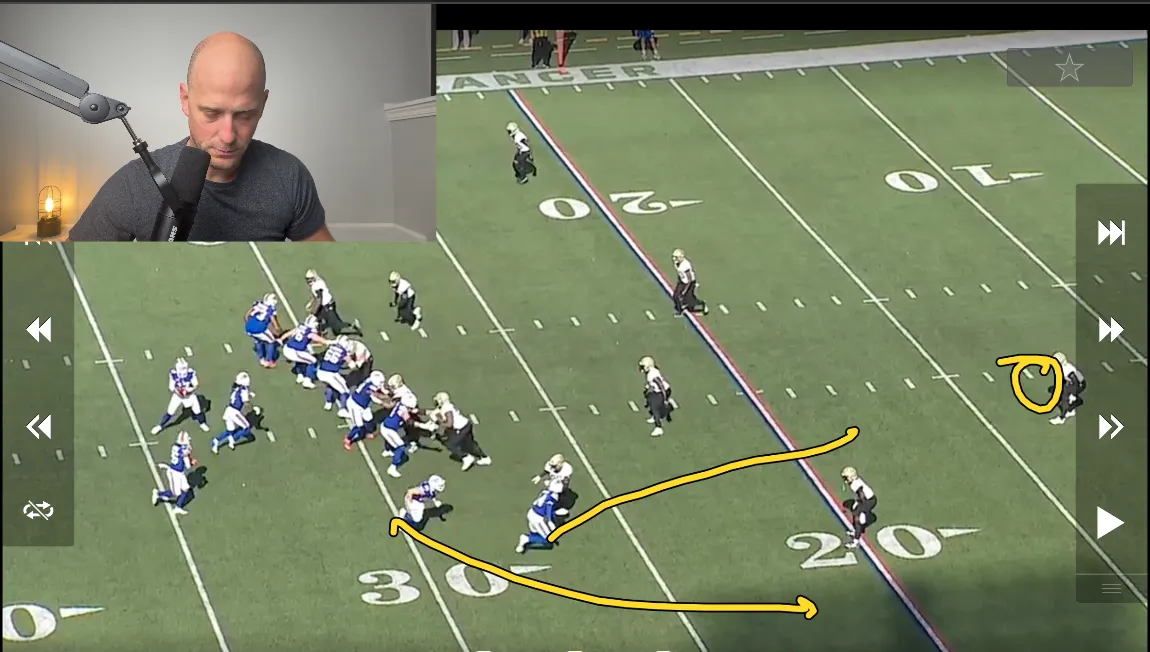
Session 3: The Install and Practice Plan
You have an offense on paper. Now you build the teaching plan.
What goes in on Day 1 of camp. What gets layered Day 2, Day 3, Week 2, Week 4. The drills that teach the reads. The walk-throughs that get the line on the same page. The weekly practice scripts that match how the offense actually fits together.
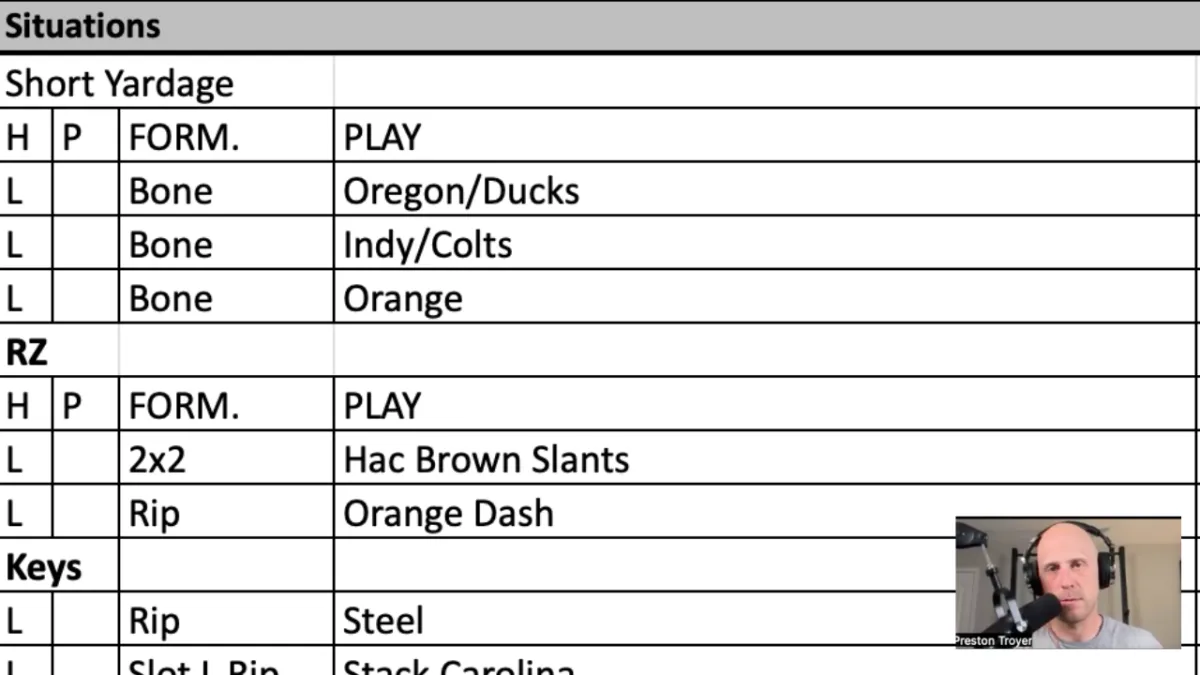
Session 4: Game Planning
You have the offense built. Your kids are running it. Now you build the weekly process that turns Sunday film into Friday calls — without burning the staff out.
How you watch film. How you decide what the defense is going to give you. How you pick what to call from the offense you already have. How the call sheet comes together. How you adjust when something gets taken away mid-game.
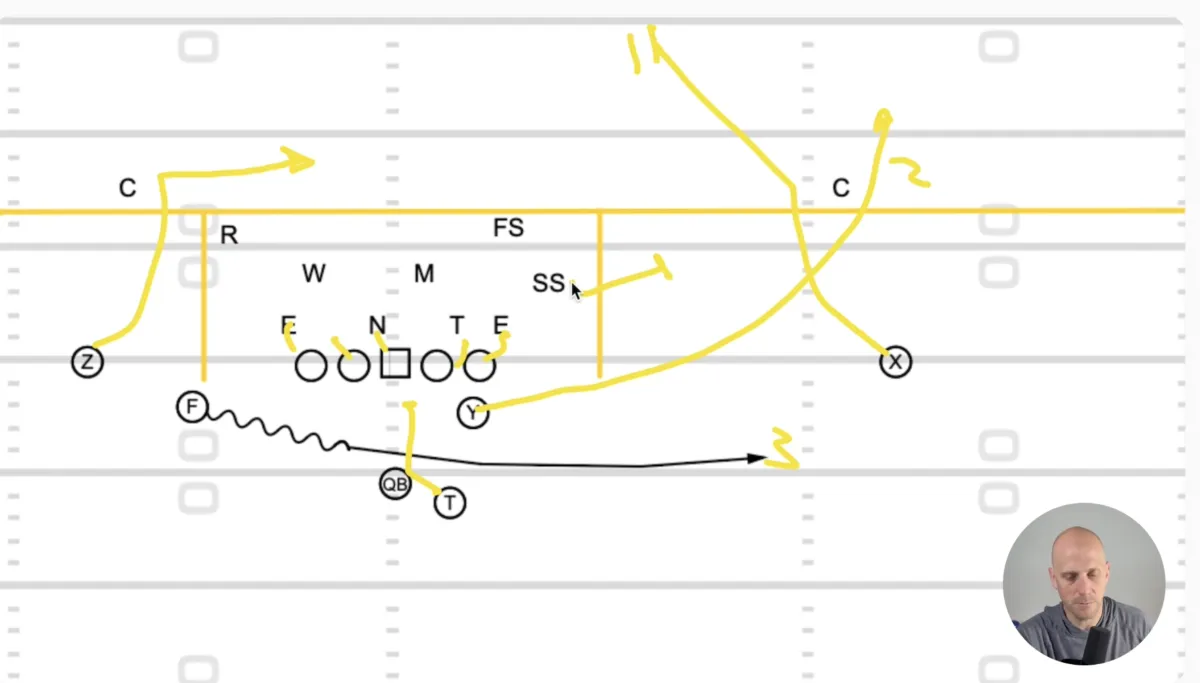
Every session is recorded. If you miss one, you watch the recording before the next Wednesday and bring your questions to the room.
You're NOT Doing this Alone
OOS Community
Four Tuesday nights is the spine. The other six days of the week are where you sketch your North Star and run it past the rest of the coaches in the group and me.
Where you post your install schedule and ask a coach who's building alongside you what he'd change.
Where you ask the kind of question you don't want to ask in a public Facebook group.
I'm in there , answering questions, reviewing what coaches are building, and pushing back on the parts that won't survive a Friday night.
"I'm an old triple-option guy and I like the idea of basing out of one play and making it our identity. Appreciate the work you're doing." — Kevin Agnew
Results from coaches who've already built this with me.
These are real coaches, real programs, real seasons.
A coach who went 10-3 last fall. Same kids he'd had the year before. Same league. The thing he changed was the system underneath the plays.
A coach whose senior class set a state record for career receiving touchdowns at his level. 35.5 points per game. 391 yards of total offense per game. 6.2 yards per carry. He came in already winning — and went looking for me because he didn't want to keep relying on his talent to bail him out.
A coach who went 10-1 averaging 49 points a game. His program was already good when he signed up. By August, his offense was at a level he hadn't gotten it to in any of his previous seasons.
A coach who broke 30 points a game after years of sitting in the low twenties.
The pattern across all of them: they didn't add plays. They built a system underneath the plays they already had.
Why This Works Where Other Things Didn't
Group Accountability
This is what I wish I'd had when I was a young OC. Someone who'd already figured it out, in the room with me, showing me exactly how to build this. You're not piecing it together from a YouTube playlist. You're building your offense in real time, with me and a room of OCs going through the same offseason at the same time. The questions you don't even know to ask yet ... somebody in the room asks them. You get the answer before you knew you needed it.
It's built around your offense, not mine.
I don't care if you run wide zone, power, counter, mesh, buck sweep, four verts, or veer. The framework wraps a system around the play you hang your hat on. The scheme is yours. The architecture is what's been missing.
It's the framework that produced the numbers above.
It's the same framework I rebuilt my own offense around after the 10-3 night ... and the same framework the coaches in the results section used to put up the numbers they did. Same framework I'll teach you in four weeks.
Here's What you Get Today:
Four 60-minute live sessions with Preston ... Starting Wednesday, June 24th. ($800 Value)
The OOS Community ... direct access to Preston and a room of OCs building their systems alongside you ($200 Value)
The 1-on-1 Offensive Evaluation with Preston ... first 20 buyers only ($500 Value)
The Core Playbook Library ... Core Playbook, Game Planning Vault, and the Wide Zone Manuals included ($200 Value)
Lifetime access ... every future version of OOS Live included, for life ($400)
Total Value: $2100
Founding Group
$397
(Or 3 Payments of $147)
Founder's Launch Bonus #1
1-on-1 Offensive Evaluation - First 20 Buyers Only
For the first twenty coaches who enroll, you get a one-hour, one-on-one call with me, with your current offense in front of us.
We go through it together. I answer every question you have. We identify the gaps and walk through exactly how to fix them inside the framework you're building.
There are twenty of these and that's it. After the twentieth coach claims his, this bonus is closed for the rest of the launch.
(All one-on-one calls will take place after the 4 sessions)
Founder's Launch Bonus #2
The Core Playbook Library
Three of my paid resources, bundled into the founding cohort at no additional cost.
The Core Playbook ($48). My complete offense as a fully-annotated worked example. Every concept, every complement, the full pass game, explained as decisions and not just plays. You'll have this in your hands while you build yours, so you can see how a finished system fits together while you're putting yours into the shape that fits your kids.
The Game Planning Vault ($57). My weekly game-planning workflow. The film checklist, the in-game adjustment process, the call-sheet structure I use every Friday.
The Wide Zone Manuals ($17.99). The most detailed breakdown of wide zone, Deep Choice, and Keepers I've ever put on paper. Worth keeping on your desk whether you base out of zone or not.
"Your stuff's legit. Never bought a subscription before — so that's saying something."
West Valley Football

The Show-Up-and-Do-the-Work Guarantee.
Here's the deal.
Attend all four live sessions. Do the work alongside the everyone — comment in the group.
If you put in the work and don't see any benefit I'll fully refund you.
Who Is This System For?
High school OCs who've spent at least one offseason staring at a list of plays that won't quite become a system.
Head coaches who call their own offense and are tired of starting from scratch every March.
Position coaches who want to be ready when the head coach gives them the nod.
Coaches who've been to the clinics, watched the cutups, and still can't make it fit together.
Coaches who'd rather walk into camp this August with one clear system than another binder full of hope.
Who Is This System NOT For?
Coaches looking for a fill-in-the-blank playbook to copy-paste.
Coaches who'd rather chase a trendy scheme every offseason than build a real structure.
Coaches who think their kids' talent is the only thing that matters.
Frequently Asked Questions
Talent is what wins games. Does scheme really matter that much?
Talent matters. Talent is the ceiling.
But your system is the floor.
Talented teams without a system get bailed out by their kids on the easy nights and get exposed on the hard ones.
A system is what makes sure the talent you do have actually gets fully expressed every Friday ... and a system is what gives you a shot when the talent on the other sideline is better than yours.
You can't control talent. You can control the system.
Do I get feedback or support?
Yes. Once you enroll, you're inside the OOS community where I'm there every week answering questions, working through installs, and helping coaches apply the framework to their own offense.
What if I already have an offense?
Good. You're supposed to. OOS isn't here to replace your playbook. It's here to organize it. You keep your plays. You just stop guessing how to use them.
Does this just work for high school?
The framework was built at the high school level, but the principles apply at any level. Whether you're working with middle school, JV, varsity, or higher, the question Core Playbook forces you to answer is the same: what is your offense built on, and what gets added around it?
How long do I have access?
Once you pay, you have lifetime access to all current and future modules, updates, and community support. Move at your own pace. Come back to it any time.
Is there a guarantee?
Yes. If you show up and stay for all 4 live sessions. and post in the community, and you still don't think it has helped your offense, I will refund you.
One Last Thing
If you've been stuck, it's not because you don't care or you don't work hard enough.
It's because everything you were ever taught about building offense told you to add.
More plays. More tags. More answers.
Nobody taught you to subtract.
So if you've spent years feeling like you're working harder than the offense should require ... that's not a you problem. That's a structure problem.
Now you can see it.
And that means you have a decision to make. Before June 24th, when the cart closes and the founding group starts.
If the answer is yes ... then give yourself permission while you're at it.
Permission to stop adding plays you don't need.
Permission to stop watching cutups at midnight looking for the wrinkle that fixes everything.
Permission to stop rebuilding from scratch every March.
Permission to walk into camp this August with one clear system instead of a binder full of hope.
That's what the founding group is.