

Adapting vs. Abandoning Your System
Why evolving your offense every year doesn't mean starting over.

Every spring, the same conversation happens in coaching offices across the country.
A coach looks at his returning roster, sees something different from last year, and starts questioning everything.
“Maybe we should go Spread this year. We’ve got a dual-threat guy, maybe it’s time to look at the option.”
“Our line is huge this year, maybe we just go Power and Iso.”
And just like that, three years of system-building gets thrown in the trash.
I get it. The instinct makes sense. You coach the players you have. But there’s a difference between coaching your players and chasing your players.
One builds something. The other starts over every August.
Your System Has to Live Somewhere
Before we talk about adapting, we have to settle one thing.
You need a foundation that doesn’t change.
That doesn’t mean it has to be the same exact play every year.
But a philosophy. A way of attacking defenses that you understand deeply enough to teach, adjust, and trust no matter who’s in your lineup.
For us, that’s always been Zone concepts. We major in Wide and Inside Zone. That is our identity.
What can change from year to year is the emphasis.
And that distinction, emphasis vs. identity, is where most coaches get lost.
What Adapting Actually Looks Like
Here’s a real example.
We’ve traditionally have smaller, quicker offensive linemen. Wide Zone is a natural fit. The horizontal movement, the combo blocks, the cutback, it plays to their athleticism.
But let’s say this year the group coming back is bigger. Stronger. Built more like a power unit than a finesse unit. They are strong, but don’t move as well laterally.
Do I scrap Wide Zone and install Gap schemes from scratch?
No. But I shift my North Star.
Inside Zone becomes the base. Same zone principles, but now we’re going downhill more. We’re leaning into their size.
Wide Zone doesn’t disappear, it becomes a complement, a way to attack certain fronts and the natural tightening of defenders when you attack downhill.
But we’re hanging our hat on something that fits this group.
The system didn’t change. The emphasis did.
The Dual-Threat Example
Same idea from a different angle.
You’re a gap scheme team. Counter is your core. Your kids can run it in their sleep: the pulls, the angles, the combos. You’ve repped it a thousand times.
This year you’ve got a dual-threat quarterback who can hurt people with his legs.
The wrong answer is to scrap your gap scheme and install a zone read system, or move to the flexbone. (Nothing wrong with either of those offenses.)
One way you could adapt is Counter Read.
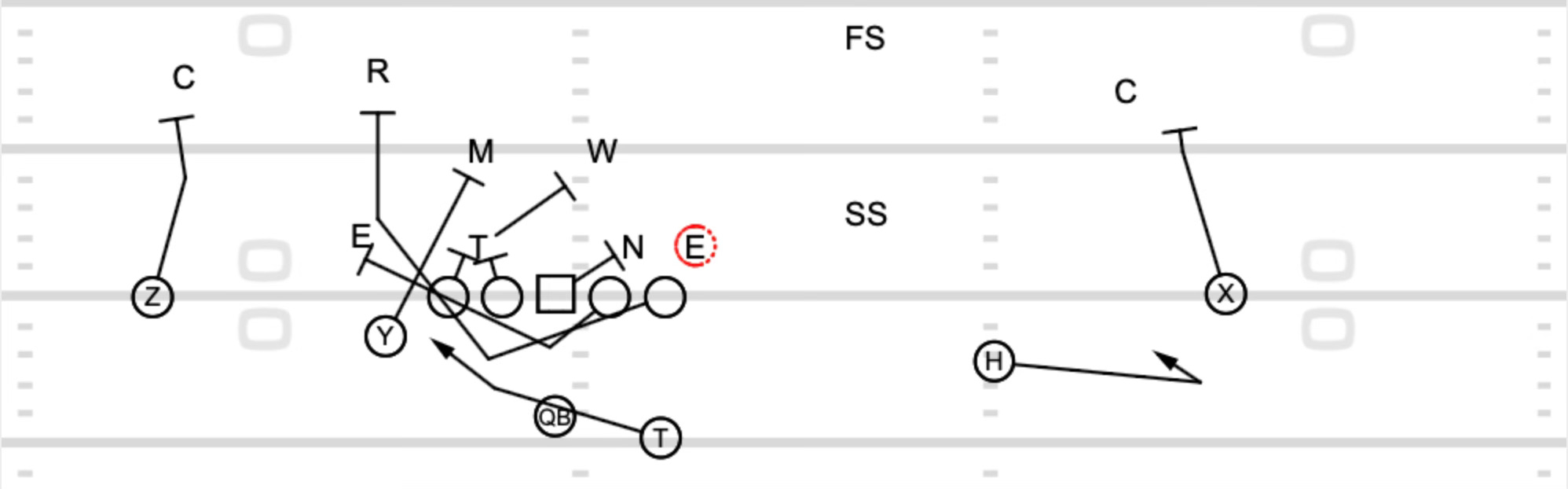
Leave the backside end unblocked. Let the QB read him.
Your O-line is blocking the exact same Counter they’ve blocked for three years. Your line coach is teaching the same footwork, the same angles, the same techniques.
You haven’t added burden. You’ve added a dimension.
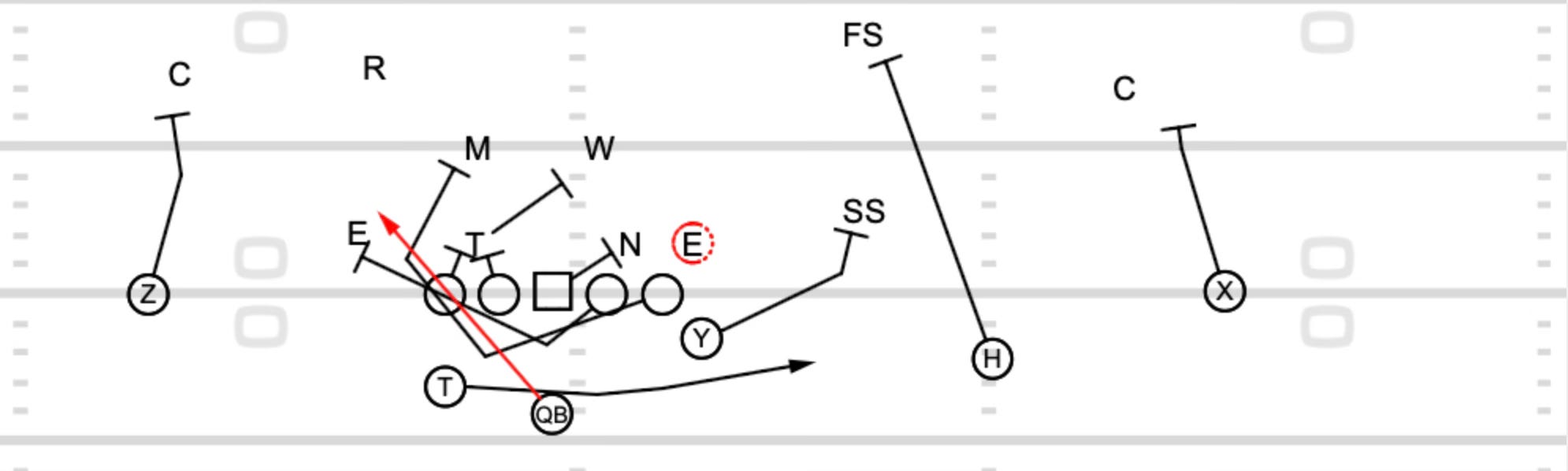
Take it a step further. Counter Bash Sweep one way, QB Counter the other. Again, the line isn’t learning anything new. You’re just maximizing what you have.
The examples are endless. But the principle is always the same.
Why Coaches Abandon Instead of Adapt
It usually comes from one of two places.
The first is frustration. When things aren’t working, the easiest explanation is the scheme. So coaches chase something new — something that looks like it’s working somewhere else. They saw it on film. They went to a clinic. They bought a playbook. And they convince themselves that this is the missing piece.
But more often than not, the scheme isn’t the problem. The execution is. And execution comes from repetition, something you can’t build if you keep starting over.
The second is boredom. Losing seasons aside, sometimes coaches just get restless. They’ve run the same system long enough that the itch for something new starts to feel like necessity. So when a special talent walks in, a freak athlete, a once-in-a-generation QB, they see it as permission to finally try something different.
I’ve been there. It’s tempting.
But the kids who suffer most are the ones who never get enough reps in anything to actually master it.
The Question to Ask Every Spring
You should be evaluating your talent every single offseason. That part is non-negotiable.
But the question isn’t what system should we run this year?
The question is how do we get the most out of our system with this group?
There’s always an answer inside your existing framework. A different emphasis. A constraint tag. A complement that you’ve used sparingly but now makes sense to feature.
If you truly can’t find an answer within your system, that might mean your system isn’t actually a system. It might mean you’ve been running a collection of plays with no real connective tissue.
That’s a harder conversation. But it’s worth having.
Build Something That Lasts
The best offensive systems I’ve seen at every level share one thing.
They stick to a core every year. Maybe it isn’t identical, but there’s a thread. A philosophy. A fingerprint that stays consistent even when the personnel, the formations, and the emphasis shift.
That’s what you’re building toward.
Not a playbook that works this year. A system that works for your program. Year after year, class after class, no matter who walks through the door.
That’s the goal.
And if you're not sure where your system's foundation actually is, or if you're not sure you have one yet. That's exactly what the Core Playbook is built to help you figure out.