

Before You Build Anything, You Need to Understand This
Space, structure, and a series to build your offensive toolbox.


If you’ve followed my work, you know what I’m about.
One play.
Add only what’s necessary.
Master what you have before you add more.
But here’s what I don’t talk about enough.
Every coach is at a different point in his journey. Some of you have been running an offense for 15 years. Some of you are calling plays for the first time next fall.
Before any of us can build a system worth running, we need a shared foundation.
That’s what this upcoming series is.
Starting next week, we’re going deep on every defensive structure you’ll face: coverages, fronts, and the concepts that attack them.
One per week.
No fluff.
Just what you actually need to know.
It starts with space
I learned how to best look at space from Dub Maddox. If you haven’t purchased any of his materials you are missing out.
Before we dive into each specific category, we must understand how the offense creates space, and how the defense takes it away.
Every offensive player creates a bubble of space.
Players in the run box create gaps.
Receivers Split out create outside or flat space
Your five eligible receivers create deep space.
No matter the formation, your offense creates 15 bubbles of space every single play.
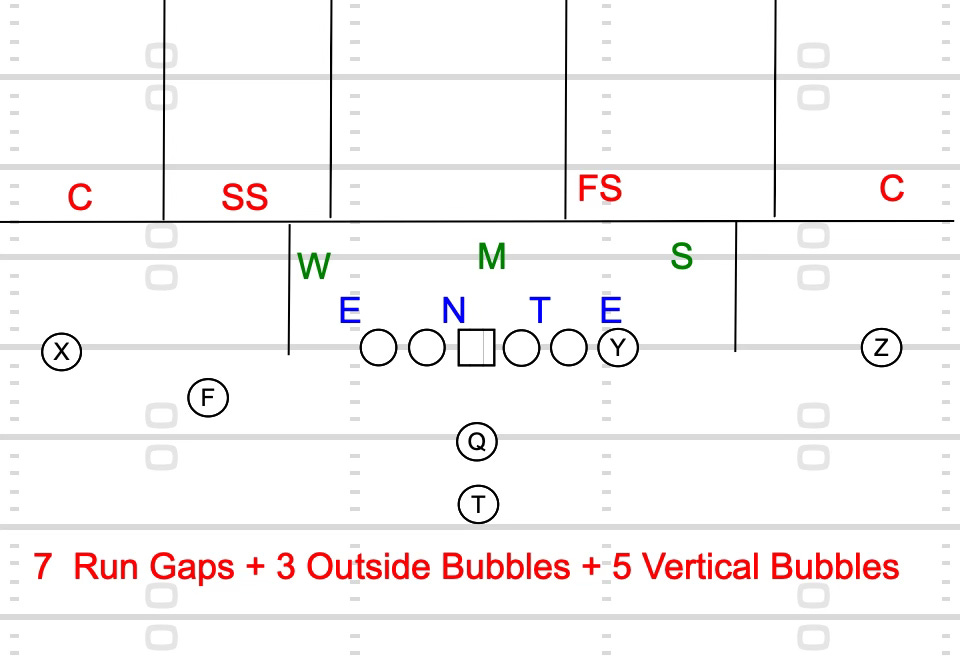
In the example above the 5 Linemen + the tight end create 7 run gaps.
The 3 split receivers create immediate space for quick game, screens, etc.
An offense in most situations (unbalanced ineligibles excluded) has 5 potential vertical threats on any given play creating 5 vertical bubbles.
7+3+5=15.
The defense only has 11 players.
That’s the starting point you need.
Once you understand this concept, and how it applies to your offense, we can start to learn how defenses take away space, and use leverage, alignment, and numbers to minimize these bubbles.
(If you want to learn this in depth I suggest you pick up the book What is Open?)
Here’s where we’re going
Coverages: Cover 0, 1, 2, 3, 4.
Fronts: 4-2, 4-3, 3-4, 3-3.
Then the most used:
run concepts
play-actions
drop back concepts
quick game
screens.
This is the toolbox. What you pull out of it depends on your North Star play and the players in your program.
By the time this series is done, you’ll have a complete reference for building an offense from scratch.
Every week, paid subscribers get a cheat sheet. One page. Print it, keep it, reference it when you’re building.
One more thing
There is no perfect play. There is no perfect offense.
What wins is a coordinator who understands the game deeply enough to make fast, confident decisions with what he has.
That’s what we’re building here.
If you want to be part of a group of coaches already building this together, Core Playbook is the place.
Next week: Cover 4. The most used coverage in high school football. What it is, why defenses love it, and exactly where it’s vulnerable.