

I Lost 25 Straight Games Chasing the Wrong Thing
The difference between inheriting knowledge and building a system

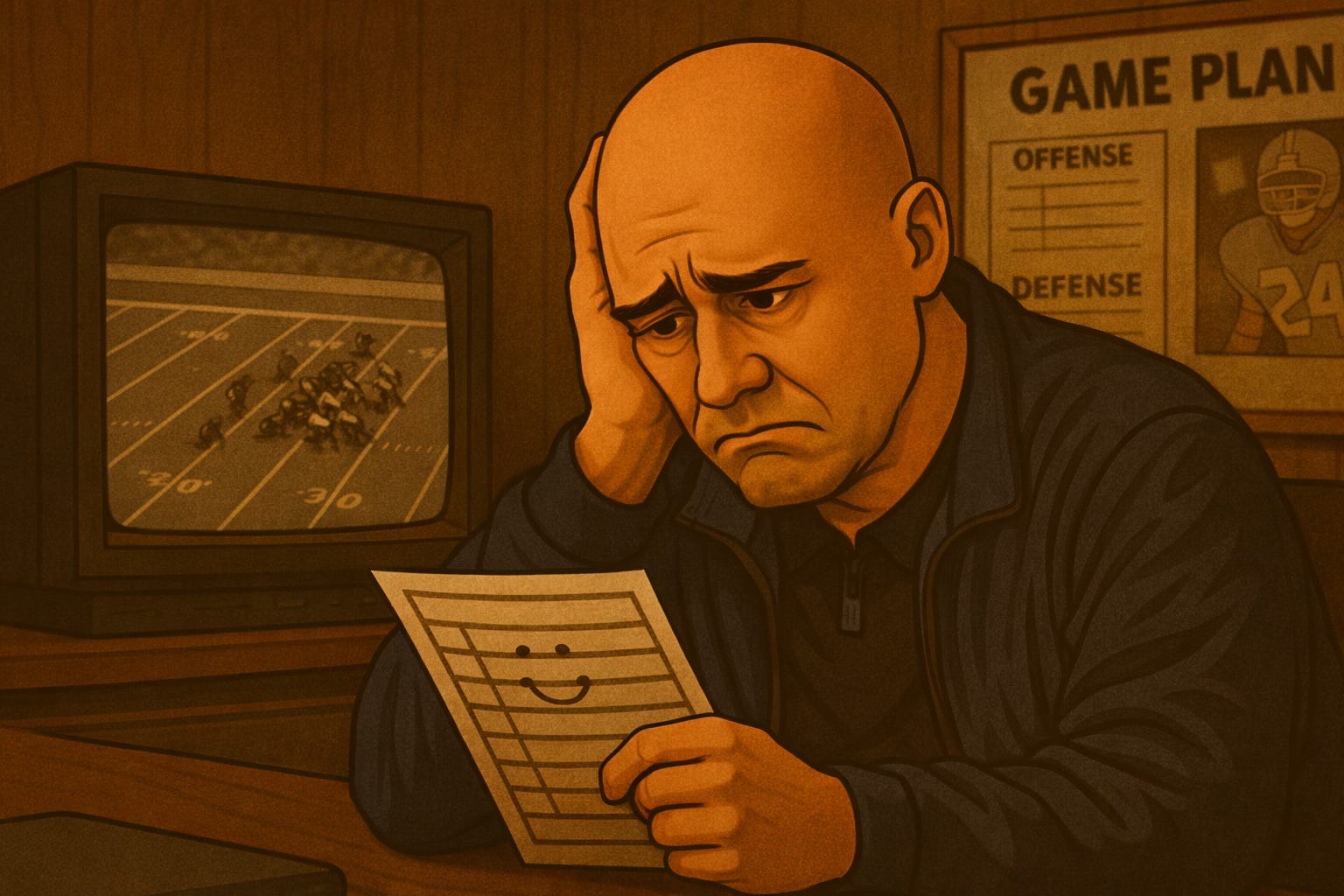
The first sound I remember is a whistle. Sharp, repeating, echoing off metal bleachers in an empty stadium.
I was four years old, standing on a sideline I wasn’t supposed to cross, watching a team run plays I didn’t understand yet.
Football has never felt like a choice, it’s felt inevitable.
For 36 of my 40 years, I’ve been inside this game. Four years in college were the only break. The rest were watching my dad’s teams from the sidelines, playing, or coaching.
I grew up in locker rooms. I fell asleep to the sound of clickers and film. I learned to read defenses with salt and pepper shakers at restaurants.
By the time I started coaching, I thought I had it all figured out.
I was 22. And I was sure.
The Certainty
When you grow up inside something, you start to believe you own it.
I didn’t stumble into coaching. I inherited it. And that felt like an advantage.
I knew the language. I knew the systems. I grew up in Texas and got to be apart of one of the best programs in the 90s.
The old Texas stadium was like a 2nd home.
So when I stepped onto the field as a coach for the first time, I wasn’t nervous.
I was confident.
I knew football.
Or at least, I thought I did.
The Friction
My first coaching job was at a program that had never won.
Not “never won a championship.” Never won. Period.
Their last playoff appearance was over two decades old.
I walked in thinking all they needed was good coaching.
I was right about that, but they weren’t going to get it from me.
We lost 25 straight games. Not close losses. Not “we were in it until the fourth quarter” losses. Mostly running clocks.
We were crushed.
The gap between what I knew and what was actually happening wasn’t a gap. It was the Grand Canyon.
I knew football. I’d been around it my entire life. But I had no idea how to turn that knowledge into something real. And every Friday night, the scoreboard reminded me.
The Expensive Detour
So I did what most coaches do when things aren’t working.
I learned more. I went to every clinic I could afford. I bought playbooks and DVDs. (Yes, I’m old)
I studied the Wing-T, the Flexbone, the Air Raid, the Spread. I watched film of teams that were lighting up scoreboards and tried to reverse-engineer what they were doing.
I spent thousands of dollars trying to figure out what I was missing. And I kept accumulating. More plays. More formations. More answers to problems I thought I had.
But the more I learned, the more scattered I became. I wasn’t building a system. I was hoarding information.
The False Peak
At 26, I got my first offensive coordinator job.
Finally. All that study. All that effort. Now I was in charge.
I had the authority. I had the answers. I had a playbook thick enough to run three different offenses depending on the week. I thought this was the breakthrough.
It wasn’t.
I had knowledge. But I didn’t have structure. I could call plays, but I couldn’t build a system. I could teach concepts, but I couldn’t get kids to execute them with confidence.
We’d have moments. A game here or there where things clicked. But we were inconsistent. We fluttered.
And I knew it was my fault.
The Question I Didn’t Want to Ask
The quiet thought started creeping in late at night, sitting alone in my office after losses.
I have all of the answers.
So why am I failing?
I wasn’t just losing games. I was losing confidence in myself. And I didn’t have a clean excuse.
The Clinic That Changed Everything
One night sitting in my classroom in between parent-teacher conferences I was watching an Alex Gibbs clinic on YouTube.
And in this clinic, he walked through his Wide Zone system. Not a single play, a one play system.
I sat there, taking it all in.
This guy operated at the highest level of football, against the best defensive minds in the world. And he did it focusing on 1 play.
Meanwhile, I was trying to install 40 concepts in a high school offense because I thought more would help us win.
I couldn’t unsee it.
The Pattern
Once I saw it with Gibbs, I started seeing it everywhere.
I went back through every system I’d studied. The Wing-T. The Flexbone. The Air Raid. Different philosophies. Different ideas. But the same architecture.
Every single one of them started with one anchor. One core concept. And everything else built outward from that point.
Simplicity wasn’t a compromise. It was the foundation.
And I’d missed it completely.
The Surrender
Letting go of what you know is harder than learning something new.
I had to strip away plays I loved. Concepts I’d spent years studying. Ideas I thought made were necessary.
It felt like risk. Like I was limiting myself. But once I gave in, everything changed.
I picked one core run concept. One core pass concept. And I built everything else as a constraint off of those two.
I stopped chasing. I started refining. And for the first time in my career, I felt like I was coaching instead of reacting.
What Changed
The scoreboard changed, but that’s not the part that mattered most.
What changed was clarity.
My players started playing faster. They weren’t thinking. They were reacting. My play-calling felt lighter. I wasn’t searching for the perfect call. I was working within a structure I trusted.
Practice became sharper. We weren’t installing new things every week. We were perfecting the things we already ran.
Coaching stopped feeling like chaos.
It started feeling like a craft.
Why I’m Writing This
I’m here because I’ve seen the trap.
Young coaches, smart coaches, experienced coaches, all chasing the same thing I chased: more.
More plays. More systems. More answers. But more isn’t the answer.
Clarity is. Structure is.
A system you can teach with confidence, rep with consistency, and trust on Friday night is.
I’ve been coaching for 17 years now. I’ve called games in blowouts, shutouts, and everything in between. And I can tell you this with certainty: the wins didn’t come from the plays. It came from mastery and execution
This Substack isn’t about selling you plays.
It’s about helping you find your core.
Whether you’re running gap or zone schemes, pass or run first. Whether you’re in your first year or your 20th.
The principles are the same.
Start with one thing. Build from it. Trust it.
I spent years overcomplicating this game. I don’t want you to waste the same time I did.
So if you’re looking for clarity, for structure, for a way to turn what you know into something your kids can execute with confidence, you’re in the right place.
Let’s build something simple.
Let’s build something that works.
Want to see exactly how I build an offense from the ground up? The Core Playbook walks you through the exact process of building simplicity, from choosing your anchor concept to constraining defenses without adding complexity. It's the system I wish I had when I started.